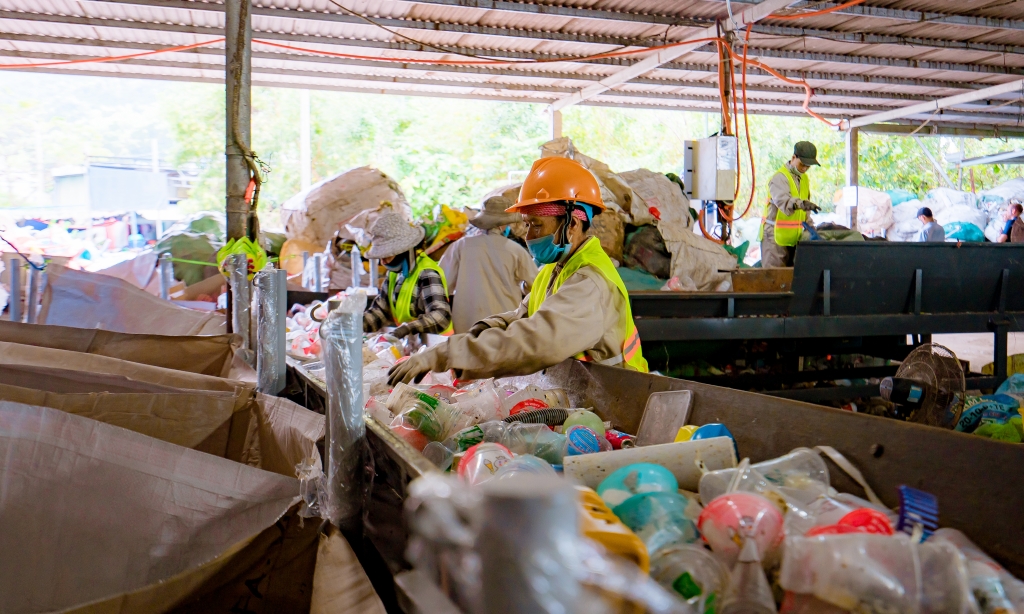
Too often, well-meaning aid programs meet bare-minimum standards of quality — just “good enough” for the world’s poorest people. But by addressing “wicked problems” through the lens of design thinking and a social business model, one public-private partnership has been able to improve the health and livelihood of residents in eastern Congo.
China manufactures nearly a quarter of the world’s high-tech goods, but most of those goods’ microchips come from the U.S. When tension rose in U.S.-China relations, one Chinese company found an M&A win-win with a European chipmaker looking to expand in China’s market. Here’s how a CEO turned around an existential threat and supply chain weak link.
Noncommunicable diseases lead to over 90 percent of all deaths in Ukraine, many of them preventable. With technological advancements and the removal of financial barriers, one public-private partnership is working to deliver essential services to improve prevention, diagnosis, treatment and medicine to patients at little to no cost.
A leader’s job is to manage energy: their own, their reports’ and their organization’s. Virtual work poses additional challenges around all of these, especially as issues of trust and credibility have nuances obfuscated by the absence of face-to-face meetings. Professor Joe Harder provides insights on overcoming such challenges.
In the face of a pandemic, how can we be bigger than the sum of our parts? Laura Morgan Roberts addresses how to maintain and evolve culture from afar: how to bond, stay agile, ensure physical and psychological safety, promote inclusion, offer compassion, and strategically align to determine what the new normal requires — and what needs to change.
No event in modern history has driven so much change, so fast, as the coronavirus pandemic. In a world beset by the challenges presented by COVID-19, can we look into the minds of entrepreneurs to discover how businesses and individuals might start to rebuild?
As COVID-19 continues to spread, hospitals in the hardest-hit areas operate at near capacity. Professor Elliott N. Weiss believes that understanding capacity management and other fundamental concepts in operations can help us make sense of the current crisis and invites us to examine it through the lens of operations.
Epidemiology and economics: A smart containment strategy for COVID-19 could save the U.S. economy $10 trillion. Here: the effects of states easing lockdowns, putting a (literal) price on individual vs. societal costs of the disease, how to get the economy running and what changes to expect long-term, and why public health measures are so important.
A feeling so common it has an acronym: fear of missing out. But what happens when activities are unavailable due to the coronavirus? Lalin Anik, an expert on consumer behavior and social connections, discusses FOMO in the pandemic: how it’s changed shape, the effect on mental health, and how we may balance it with risk aversion as states open up.
The convergence of racism, economic downturns and public health crises reflect wicked problems in complex systems fraught with inequality. Enduring strains of racism play out overtly and subtly, both violently in the streets and systemically in the workplace. So what now? Laura Morgan Roberts offers three zones of action as we move forward.